
First, there were the “Baby Boomers”–a generation that marketers have dissected, scrutinized, and analyzed with an almost scientific precision with generational marketing. Then, there was the “Baby Bust.” These were the children born between 1964 and 1980, what we eventually called “Generation X.” Next came “Gen Y,” those born between 1981 and 1994. These, we redubbed “Millennials”–a name which has always sounded a bit like some misbegotten HBO mini-series.
Now, marketers are poking and prodding the so-called “Generation Z,” those born since the mid-90s who grew up in the gloomy realities of Middle Eastern wars, global terrorism, and under-employed parents.
But hey, there was also the iPhone. That was kind of fun.
And now, we have already arrived at the end of the generational alphabet. That was poor planning! So why do marketers fixate so much on these sorts of psychographic demarcators?
“Marketers have always liked segmentation,” explains Matt Carmichael, author of Buyographics. “It’s a way to put convenient labels on consumers so you can understand them better.”
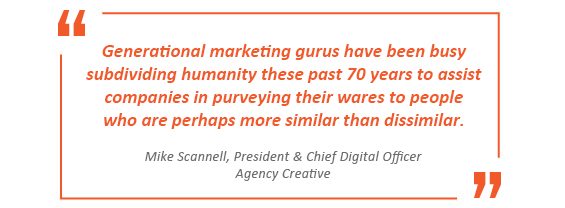
Generational marketing gurus have been busy subdividing humanity over the past 70 years to help companies sell their wares to people who are perhaps more similar than dissimilar. Understanding the differences and forecasting the trends can be helpful when you are selling stuff. You don’t try to sell ice cubes to Eskimos after all.
Why the differences?
What accounts for these differences in behavior and disposition? Well, world events for one. Social scientists will point to the differences between the easily dissatisfied Millennials and the hunkered-down pragmatic Gen Z’ers. One group saw their peaceful bubble abruptly burst with the 9/11 attacks. The younger Gen Zers have always lived in an unsteady world of warfare, the Great Recession, and high unemployment.
But world events can only have so much influence, unless, of course, you have the misfortune of living in a refugee camp. A more likely culprit in shaping these two very different generations is the parents. The Millennials are products of Baby Boomer parenting and pot-smoking, flower-power idealism. These little tots were told the world revolved around them and they should chase their dreams. They received a trophy, so the canard goes, for simply showing up in life.
The Gen Z kids, on the other hand, were the offspring of Gen X’ers who, for the most part, worked hard, paid their dues, and moved up into middle management. They filled their children’s heads with low expectations and a significantly reduced sense of entitlement. The result is a cautious, levelheaded bunch of independent worker bees.
But don’t generations and individuals evolve?
The communal hippie Baby Boomer no longer drives a Volkswagen minivan; he drives a Lexus SUV. The hipster Millennial has moved out of her parents’ basement and into the suburbs. And might not the cautious Gen Z’er one day throw all caution to the wind? Of course!
What comes next for generational marketing?
So what comes after Generation Z?
“It will be a lot trickier to come up with a consensus for the next one,” says Carmichael. “So many groups are competing to come up with the clever name. But I’m sure we’ll figure it out. At some point, it just becomes better to have one big name.”
Futurist and demographer Mark McCrindle is already calling anyone born after 2010 a part of “Generation Alpha.” Frankly, it sounds like the name of a sci-fi movie to me, but what do I know about naming generations? I had a hard enough time picking out middle names for my kids!
Need help crafting your generational marketing message to your target audience? Agency Creative would love to help. Give us a jingle at 972.488.1660.
We are a Dallas advertising agency with expertise in integrated generational marketing.

